Dsa Full cource
- Get link
- X
- Other Apps
- Learn Data Structures and Algorithms | DSA Tutorial
- Array Data Structure
- String in Data Structure
- Linked List Data Structure
- Stack Data Structure
- Queue Data Structure
- Tree Data Structure
- Heap Data Structure
- Hashing in Data Structure
- Graph Algorithms
- Matrix Data Structure
- Introduction to Set – Data Structure and Algorithm Tutorials
- Introduction to Map – Data Structure and Algorithm Tutorials
- Advanced Data Structures
- Data Structures Tutorial
- Searching Algorithms
- Sorting Algorithms
- Recursion Algorithms
- Backtracking Algorithm
- Greedy Algorithms
- Dynamic Programming or DP
- Pattern Searching
- Divide and Conquer Algorithm
- Mathematical Algorithms
- Geometric Algorithms
- Bitwise Algorithms
- Randomized Algorithms
- Branch and Bound Algorithm
- Algorithms Tutorial
- Competitive Programming - A Complete Guide
- DSA to DevelopmentCourse
Data Structures Tutorial
Algorithm Tutorial
Competitive Programming
Recursion Algorithms By Umang
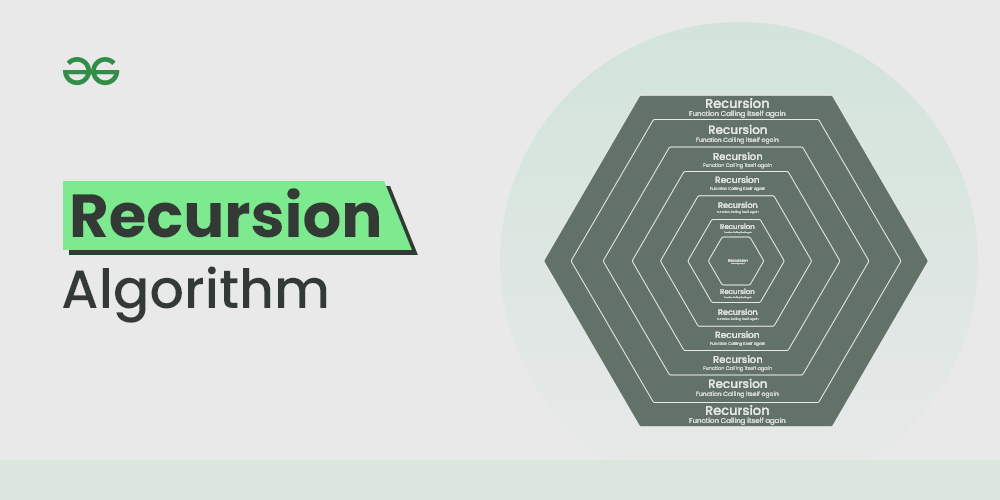
Recursion is technique used in computer science to solve big problems by breaking them into smaller, similar problems. The process in which a function calls itself directly or indirectly is called recursion and the corresponding function is called a recursive function. Using a recursive algorithm, certain problems can be solved quite easily.
What is Recursion?
Recursion is a programming technique where a function calls itself within its own definition. This allows a function to break down a problem into smaller subproblems, which are then solved recursively.
How Does Recursion Work?
Recursion works by creating a stack of function calls. When a function calls itself, a new instance of the function is created and pushed onto the stack. This process continues until a base case is reached, which is a condition that stops the recursion. Once the base case is reached, the function calls start popping off the stack and returning their results.
What is a Recursive Algorithm?
A recursive algorithm is an algorithm that uses recursion to solve a problem. Recursive algorithms typically have two parts:
- Base case: Which is a condition that stops the recursion.
- Recursive case: Which is a call to the function itself with a smaller version of the problem.
Types of Recursion
There are several different recursion types and terms. These include:
- Direct recursion: This is typified by the factorial implementation where the methods call itself.
- In-Direct recursion: This happens where one method, say method A, calls another method B, which then calls method A. This involves two or more methods that eventually create a circular call sequence.
- Head recursion: The recursive call is made at the beginning of the method.
- Tail recursion: The recursive call is the last statement.
When to Use Recursion?
Recursion is a powerful technique that can be used to solve a wide variety of problems. However, it is important to use recursion carefully, as it can lead to stack overflows if not used properly.
Recursion should be used when:
- The problem can be broken down into smaller subproblems that can be solved recursively.
- The base case is easy to identify.
- The recursive calls are tail recursive.
Examples of Recursion
Here are some common examples of recursion:
Example 1: Factorial: The factorial of a number n is the product of all the integers from 1 to n. The factorial of n can be defined recursively as:
factorial(n) = n * factorial(n-1)Example 2: Fibonacci sequence: The Fibonacci sequence is a sequence of numbers where each number is the sum of the two preceding numbers. The Fibonacci sequence can be defined recursively as:
fib(n) = fib(n-1) + fib(n-2)Applications of Recursion Algorithms:
Here are some common applications of recursion:
- Tree and Graph Traversal: Depth-first search (DFS) and breadth-first search (BFS)
- Dynamic Programming: Solving optimization problems by breaking them into smaller subproblems
- Divide-and-Conquer: Solving problems by dividing them into smaller parts, solving each part recursively, and combining the results
- Backtracking: Exploring all possible solutions to a problem by recursively trying different options
- Combinatorics: Counting or generating all possible combinations or permutations of a set
Learn Basics of Recursion Algorithms:
- Introduction to Recursion – Data Structure and Algorithm Tutorials
- What is Recursion?
- Difference between Recursion and Iteration
- Types of Recursions
- Finite and Infinite Recursion with examples
- What is Tail Recursion
- What is Implicit recursion?
- Why is Tail Recursion optimization faster than normal Recursion?
- Recursive Functions
- Difference Between Recursion and Induction
Recursion in Different Languages:
Easy Problems on Recursion
- Print 1 to n without using loops
- Print N to 1 without loop
- Mean of Array using Recursion
- Sum of natural numbers using recursion
- Decimal to binary number using recursion
- Sum of array elements using recursion
- Print reverse of a string using recursion
- Program for length of a string using recursion
- Sum of digit of a number using recursion
- Tail recursion to calculate sum of array elements.
- Program to print first n Fibonacci Numbers | Set 1
- Program for factorial of a number
- Recursive Programs to find Minimum and Maximum elements of array
- Recursive function to check if a string is palindrome
- Count Set-bits of number using Recursion
- Print Fibonacci Series in reverse order using Recursion
- Coin Change | DP-7
Medium Problems on Recursion
- Recursively remove all adjacent duplicates
- Sort the Queue using Recursion
- Reversing a queue using recursion
- Binary to Gray code using recursion
- Delete a linked list using recursion
- Product of 2 Numbers using Recursion
- Programs for Printing Pyramid Patterns using Recursion
- Length of longest palindromic sub-string : Recursion
- Program for Tower of Hanoi Algorithm
- Time Complexity Analysis | Tower Of Hanoi (Recursion)
- Program to calculate value of nCr using Recursion
- Find geometric sum of the series using recursion
- Convert a String to an Integer using Recursion
- DFS traversal of a Tree
- Bottom View of a Binary Tree using Recursion
- Write a program to print all Permutations of given String
- Print all subsets of a given Set or Array
- Print all possible paths from top left to bottom right of a mXn matrix
- Print all combinations of balanced parentheses
- Longest Common Subsequence (LCS)
Hard Problems on Recursion
- Find the value of a number raised to its reverse
- How to Sort a Stack using Recursion
- Reverse a Doubly linked list using recursion
- Given a string, print all possible palindromic partitions
- Check if a string is a scrambled form of another string
- Word Break Problem | DP-32
- Print all palindromic partitions of a string
- N Queen Problem | Backtracking-3
- Algorithm to Solve Sudoku | Sudoku Solver
- The Knight’s tour problem
Practice Sets on Recursion
- Recursive Practice Problems with Solutions
- Practice Questions for Recursion | Set 1
- Practice Questions for Recursion | Set 2
- Practice Questions for Recursion | Set 3
- Practice Questions for Recursion | Set 4
- Practice Questions for Recursion | Set 5
- Practice Questions for Recursion | Set 6
- Practice Questions for Recursion | Set 7
- Practice questions for Linked List and Recursion
Quiz based on Recursion:


Similar Reads



- Get link
- X
- Other Apps
Comments
Post a Comment